
How much does Facebook advertising really cost?
That’s a tricky question! And the short answer is, it’ll never cost you more than you have to spend. If you have a budget of $5 per day, Facebook Ads will never cost you more than $5 a day. However, there are a number of factors that will affect how far your budget will stretch and the success you’ll see for your money.
Benchmarks: How much does Facebook advertising cost?
You might be curious about the exact cost of an impression, a click, or a conversion through Facebook ads. However, since there are many factors that influence the cost of Facebook advertising, there isn’t an absolute answer to this question.
Facebook Marketing Partners like AdEspresso regularly analyze social media advertising spend. While the benchmarks will not tell you precisely how much your Facebook ad campaign will cost, they might be great reference points for your consideration.

How does Facebook decide whether to show your ads? (And why the biggest budget doesn’t always win)
- Creating value for advertisers by helping them reach and get results from people in their target audiences
- Providing positive, relevant experiences for people using Facebook, Instagram or Audience Network
So, whenever there is an ad space available, Facebook will batch together all of the ads vying for that specific space and auction the spot, with the winner of the auction having their ad shown to the end user. Billions of these auctions take place everyday.
Factors that determine the cost of Facebook Ads
* Your Bid: How interested you are in showing your ad
When you create a Facebook Ad, you’re basically joining a huge, global auction, competing with other advertisers for ad space on Facebook.
It’s important to remember that this is an auction and you are bidding against every other advertiser on the platform. This means that at any given time you have hundreds upon hundreds of other advertisers all going for the eyes of Facebook users.
Ensuring you have a good bidding strategy in place will allow you to remain competitive, and give your ads a better shot at delivery.
Your bid amount represents how interested you are in showing your ad and the higher your bid, the more likely your ad will be shown. When creating your Facebook, you can set your bid automatically or manually.

Here’s a quick breakdown of both options:
Automatic bid: If you choose automatic, Facebook decides the bid amount for you. The bid is set so that Facebook would spend your entire ad budget with the goal of maximizing the result you want. If you are unsure how much to bid, Facebook recommends choosing this option.
Manual bid: If you choose manual bid, you tell Facebook the maximum amount you’d be willing to spend to achieve the result you want (e.g. $5 for a click).
When you think about how much to bid, it’s worth keeping in mind these couple of tips from AdEspresso:
- If you try to bid too low, your campaign may not get the exposure it deserves, and you won’t reach your goals. Remember, you always get what you pay for.
- Don’t worry about bidding a high amount. You’ll still end up paying the lowest amount possible in the auction to get your ads delivered.
How does the Facebook ads auction process work?
Unlike a traditional auction, Facebook advertising space is not won with the highest monetary bid. This is because Facebook wants to provide a positive, and importantly, relevant experience for all of its users. As such, the winner of an auction is decided by the overall value created by the ad for the targeted user.
Facebook determines the potential value created by each ad by analyzing three factors:
- Advertiser bid – representing how interested you are in showing your ad.
- Ad quality and relevance – decided by how interested Facebook thinks a person will be in seeing your ad.
- Estimated action rates – calculated by how likely Facebook thinks a person will take the action you are optimizing for with your ad (for example visiting your website or downloading your app).
Whenever there’s ad real estate on Facebook up for auction, Facebook will combine the three factors into a total value and display the ad with the highest value. This means that you don’t need to have the highest bid each time to have your ad shown if your ad is of higher quality and relevance than your competitors.
After the auction is won, Facebook considers all the ads competing for that ad space and charges the winning ad the minimum amount that’s required to win the auction (meaning you won’t always be charged your maximum bid for ads on Facebook).
* Ad Quality and Relevance: How interested a person will be in seeing your ad
Facebook estimates the quality and relevance of your ad based on how it’s performing. Facebook considers both positive (e.g. number of clicks, video views, or app installs) and negative feedback (e.g. number of people who clicked “I don’t want to see this” on your ad) to decide the quality and relevance of every advert.
To help you understand how relevant your ad is to your target audience, Facebook provides a Relevance Score metric for each of your ads. When your ad’s relevance score is high, Facebook will show your ad more than ads with lower relevance scores, and you will also pay less to reach more of your target audience.
You can find your ad’s relevance score and level of positive and negative feedback in your Facebook Ads Manager.
Facebook has 3 separate metrics to determine the quality of your ad: Engagement Ranking, Quality Ranking, and Conversion Ranking. Having a low score in any of these areas will increase your costs.
* Estimated Action Rates: How likely a person will act on your ad
When deciding whether to show your ad to a person in your target audience, Facebook estimates how likely the person will take the action you are optimizing for with your ad (this is called Estimated Action Rate).
For example, if you’re running an ad for your marketing tool (like Buffer) that’s optimized for website conversions, Facebook would show your ad to people it deems likely to sign up for a product like yours. Facebook determines this based on the previous actions of the person in your target audience (“how many times has she signed up for a product through a Facebook ad?”) and your ad’s previous performance (“how many website conversions has your ad received so far?”).
If your Estimated Action Rate is low, my hunch is that the cost of your Facebook ads will be high. To make sure your ad wins some ad auctions and is shown to your target audience, Facebook might have to compensate your ad’s low Estimated Action Rate by increasing your bid (if you have chosen automatic bid).
According to Facebook,
* Your Audience Targeting: Who and how many people you are trying to reach
Who you target and how many people you target will influence your Facebook advertising cost. This is due to the level of competition to reach a particular audience. When more marketers are targeting a specific audience, it becomes more expensive to reach them.
Apart from location, the following audience details may also affect the cost of your ads:
- Age
- Gender
- Languages
- More specific demographics, interests, or behaviors
- Connections (with your Facebook Page, app, or event)
* Optimization of Ad Delivery: What your ad is optimized for
When creating your ad, if you click on “Show Advanced Options” under “Budget & Schedule”, you will find an option called “Optimization for Ad Delivery”.
Your choice for optimization here can influence who Facebook shows your ads to. For example, if you choose to optimize for clicks, Facebook will show your ad to people who are most likely to click the ad.
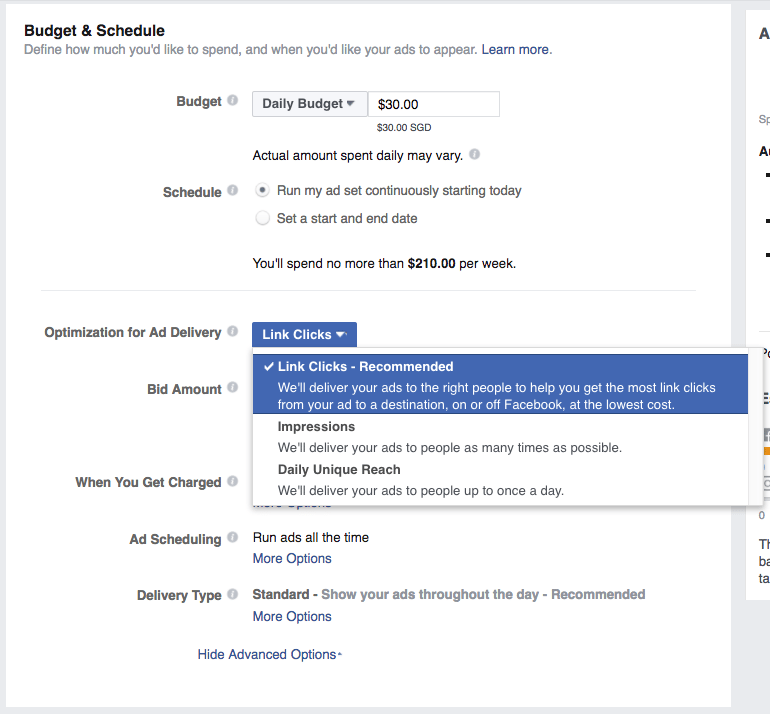
This can affect the cost of your ad because actions taken on your ad will affect your ad’s relevance score and estimated action rate (see point two and three above). If your ad is not optimized for the result you want, Facebook might not show your ad to people who are most likely to act positively on your ad and you might even end up paying more for the results.
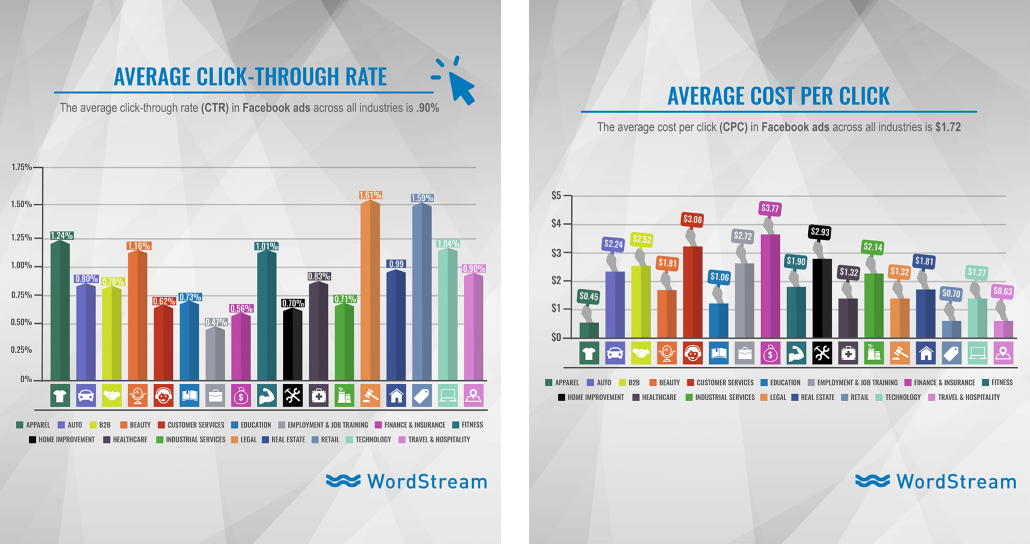
Below are the average click-through and cost per click rates (education is fairly low! 🙂 )
If this wasn’t overwhelming enough, you can get more in depth information at: https://adespresso.com/guides/facebook-ads-optimization/benefits/

